
this project makes use of a residual network to classify different classes of fish based on images.
dataset classes
- Black Sea Sprat
- Gilt-Head Bream
- Hourse Mackerel
- Red Mullet
- Red Sea Bream
- Sea Bass
- Shrimp
- Striped Red Mullet
- Trout
# install missing packages!pip -q install torchsummaryimport numpy as npimport pandas as pdimport seaborn as snsimport matplotlib.pyplot as pltimport matplotlibimport osimport torchimport torch.nn as nnimport torchvision.transforms as transformsfrom torch.utils.data import DataLoader, Dataset, random_splitfrom torchvision.datasets import ImageFolderfrom torchvision.utils import make_gridfrom torchsummary import summaryfrom tqdm import tqdmfrom sklearn.metrics import accuracy_score, confusion_matrix, classification_reportfrom pathlib import Path# set background color to whitematplotlib.rcParams['figure.facecolor'] = '#ffffff'# set default figure sizematplotlib.rcParams['figure.figsize'] = (15, 7)DATA_DIR = r'../input/a-large-scale-fish-dataset/Fish_Dataset/Fish_Dataset'exploring the images and their classes before modeling
# Get filepaths and labelsimage_dir = Path(DATA_DIR)filepaths = list(image_dir.glob(r'**/*.png'))labels = list(map(lambda x: os.path.split(os.path.split(x)[0])[1], filepaths))filepaths = pd.Series(filepaths, name='Filepath').astype(str)labels = pd.Series(labels, name='Label')# Concatenate filepaths and labelsimage_df = pd.concat([filepaths, labels], axis=1)# remove GT from some label namesimage_df['Label'] = image_df['Label'].apply(lambda x: x.replace(" GT", ""))image_df| Filepath | Label | |
|---|---|---|
| 0 | ../input/a-large-scale-fish-dataset/Fish_Datas... | Hourse Mackerel |
| 1 | ../input/a-large-scale-fish-dataset/Fish_Datas... | Hourse Mackerel |
| 2 | ../input/a-large-scale-fish-dataset/Fish_Datas... | Hourse Mackerel |
| 3 | ../input/a-large-scale-fish-dataset/Fish_Datas... | Hourse Mackerel |
| 4 | ../input/a-large-scale-fish-dataset/Fish_Datas... | Hourse Mackerel |
| ... | ... | ... |
| 17995 | ../input/a-large-scale-fish-dataset/Fish_Datas... | Red Sea Bream |
| 17996 | ../input/a-large-scale-fish-dataset/Fish_Datas... | Red Sea Bream |
| 17997 | ../input/a-large-scale-fish-dataset/Fish_Datas... | Red Sea Bream |
| 17998 | ../input/a-large-scale-fish-dataset/Fish_Datas... | Red Sea Bream |
| 17999 | ../input/a-large-scale-fish-dataset/Fish_Datas... | Red Sea Bream |
18000 rows × 2 columns
# count plot for each classsns.countplot(x='Label', data=image_df).set(title='Count of different image classes')plt.show()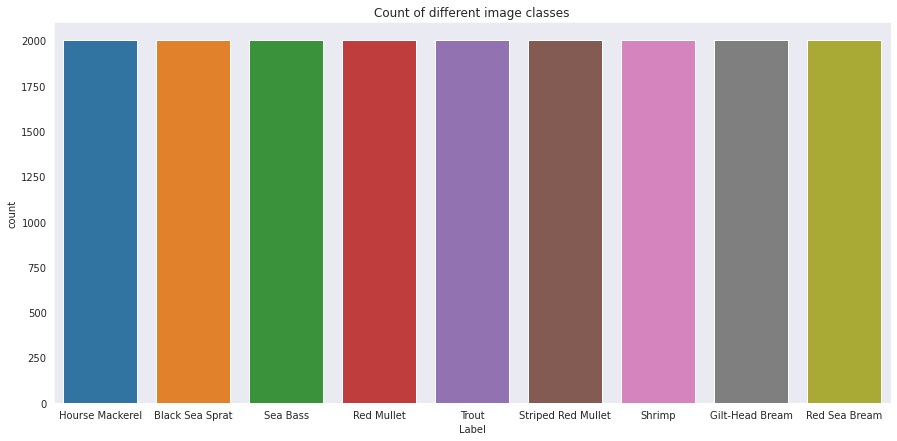
there are 2000 images of each class, which means our model won’t be biased towereds a particular class because it has a larger sample size
# the images are already augumented so no need to do any transformstrans = transforms.Compose([transforms.Resize([128, 128]), # resize to a smaller size to avoid CUDA running out of memory transforms.ToTensor() ])images = ImageFolder(root=DATA_DIR, transform=trans)# split data to train, testsize = len(images)test_size = int(0.2 * size)train_size = int(size - test_size)print(f"number of classes: {len(images.classes)}")print(f"total number of images: {size}")print(f"total number of train images: {train_size}")print(f"total number of test images: {test_size}")# random_splittrain_set, test_set = random_split(images, (train_size, test_size))number of classes: 9total number of images: 18000total number of train images: 14400total number of test images: 3600# show a single imagedef show_image(img, label, dataset): plt.imshow(img.permute(1, 2, 0)) plt.axis('off') plt.title(dataset.classes[label])show_image(*train_set[7], train_set.dataset)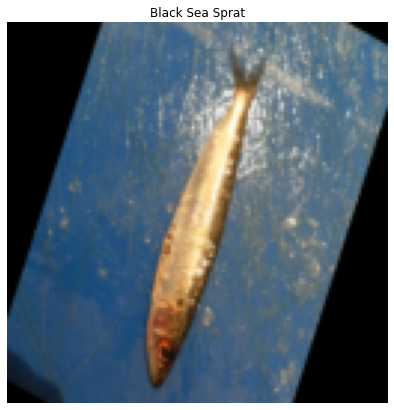
show_image(*train_set[101], train_set.dataset)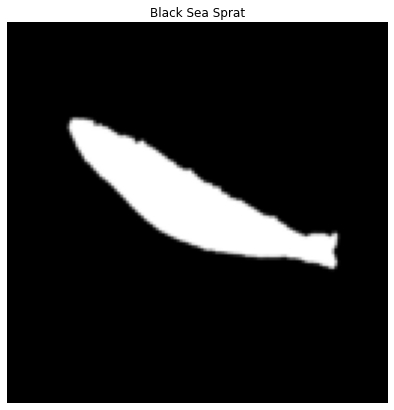
# create data loadersbatch_size = 64 # larger numbers lead to CUDA running out of memorytrain_dl = DataLoader(train_set, batch_size=batch_size)test_dl = DataLoader(test_set, batch_size=batch_size)# visualize a batch of imagesdef show_batch(dl): for images, labels in dl: fig, ax = plt.subplots(figsize=(20, 8)) ax.set_xticks([]); ax.set_yticks([]) ax.imshow(make_grid(images, nrow=16).permute(1, 2, 0)) breakshow_batch(train_dl)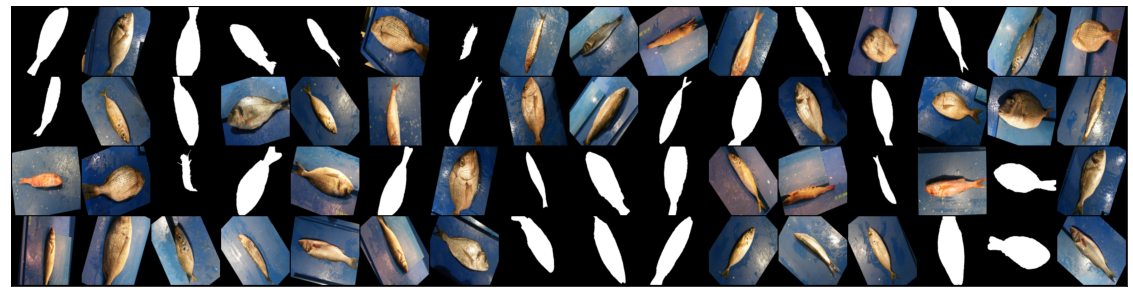
# convlutional block with batchnorm and max poolingdef conv_block(in_channels, out_channels, pool=False): layers = [nn.Conv2d(in_channels, out_channels, kernel_size=3, padding=1), nn.BatchNorm2d(out_channels), nn.ReLU(inplace=True)] if pool: layers.append(nn.MaxPool2d(2)) return nn.Sequential(*layers)# CNN with residual connectionsclass FishResNet(nn.Module): def __init__(self, in_channels, num_classes): super().__init__() self.conv1 = conv_block(in_channels, 64) self.conv2 = conv_block(64, 128, pool=True) self.res1 = nn.Sequential(conv_block(128, 128), conv_block(128, 128)) self.conv3 = conv_block(128, 256, pool=True) self.conv4 = conv_block(256, 512, pool=True) self.res2 = nn.Sequential(conv_block(512, 512), conv_block(512, 512)) self.classifier = nn.Sequential(nn.MaxPool2d(4), nn.Flatten(), nn.Dropout(0.2), nn.Linear(512 * 4 * 4, num_classes)) def forward(self, xb): out = self.conv1(xb) out = self.conv2(out) out = self.res1(out) + out # add residual out = self.conv3(out) out = self.conv4(out) out = self.res2(out) + out # add residual out = self.classifier(out) return outdevice = torch.device('cuda' if torch.cuda.is_available() else 'cpu') # choose device accordinglymodel = FishResNet(3, 9).to(device) # 3 color channels and 9 output classescriterion = nn.CrossEntropyLoss()optim = torch.optim.Adam(model.parameters(), lr=1e-3)# model summary (helps in understanding the output shapes)summary(model, (3, 128, 128))---------------------------------------------------------------- Layer (type) Output Shape Param #================================================================ Conv2d-1 [-1, 64, 128, 128] 1,792 BatchNorm2d-2 [-1, 64, 128, 128] 128 ReLU-3 [-1, 64, 128, 128] 0 Conv2d-4 [-1, 128, 128, 128] 73,856 BatchNorm2d-5 [-1, 128, 128, 128] 256 ReLU-6 [-1, 128, 128, 128] 0 MaxPool2d-7 [-1, 128, 64, 64] 0 Conv2d-8 [-1, 128, 64, 64] 147,584 BatchNorm2d-9 [-1, 128, 64, 64] 256 ReLU-10 [-1, 128, 64, 64] 0 Conv2d-11 [-1, 128, 64, 64] 147,584 BatchNorm2d-12 [-1, 128, 64, 64] 256 ReLU-13 [-1, 128, 64, 64] 0 Conv2d-14 [-1, 256, 64, 64] 295,168 BatchNorm2d-15 [-1, 256, 64, 64] 512 ReLU-16 [-1, 256, 64, 64] 0 MaxPool2d-17 [-1, 256, 32, 32] 0 Conv2d-18 [-1, 512, 32, 32] 1,180,160 BatchNorm2d-19 [-1, 512, 32, 32] 1,024 ReLU-20 [-1, 512, 32, 32] 0 MaxPool2d-21 [-1, 512, 16, 16] 0 Conv2d-22 [-1, 512, 16, 16] 2,359,808 BatchNorm2d-23 [-1, 512, 16, 16] 1,024 ReLU-24 [-1, 512, 16, 16] 0 Conv2d-25 [-1, 512, 16, 16] 2,359,808 BatchNorm2d-26 [-1, 512, 16, 16] 1,024 ReLU-27 [-1, 512, 16, 16] 0 MaxPool2d-28 [-1, 512, 4, 4] 0 Flatten-29 [-1, 8192] 0 Dropout-30 [-1, 8192] 0 Linear-31 [-1, 9] 73,737================================================================Total params: 6,643,977Trainable params: 6,643,977Non-trainable params: 0----------------------------------------------------------------Input size (MB): 0.19Forward/backward pass size (MB): 145.19Params size (MB): 25.34Estimated Total Size (MB): 170.72----------------------------------------------------------------# multiclass accuracydef multi_acc(y_pred, y_test): y_pred_softmax = torch.log_softmax(y_pred, dim = 1) _, y_pred_tags = torch.max(y_pred_softmax, dim = 1) correct_pred = (y_pred_tags == y_test).float() acc = correct_pred.sum() / len(correct_pred) acc = torch.round(acc * 100) return acc# training loopepochs = 10losses = []for epoch in range(epochs): # for custom progress bar with tqdm(train_dl, unit="batch") as tepoch: epoch_loss = 0 for data, target in tepoch: tepoch.set_description(f"Epoch {epoch + 1}") data, target = data.to(device), target.to(device) # move input to GPU out = model(data) loss = criterion(out, target) acc = multi_acc(out, target) epoch_loss += loss.item() loss.backward() optim.step() optim.zero_grad() tepoch.set_postfix(loss = loss.item(), accuracy = acc.item()) # show loss and accuracy per batch of data losses.append(epoch_loss)Epoch 1: 100%|██████████| 225/225 [04:55<00:00, 1.31s/batch, accuracy=45, loss=1.57]Epoch 2: 100%|██████████| 225/225 [02:52<00:00, 1.30batch/s, accuracy=67, loss=0.914]Epoch 3: 100%|██████████| 225/225 [02:51<00:00, 1.31batch/s, accuracy=75, loss=0.822]Epoch 4: 100%|██████████| 225/225 [02:52<00:00, 1.31batch/s, accuracy=81, loss=0.414]Epoch 5: 100%|██████████| 225/225 [02:54<00:00, 1.29batch/s, accuracy=84, loss=0.38]Epoch 6: 100%|██████████| 225/225 [02:55<00:00, 1.29batch/s, accuracy=83, loss=0.37]Epoch 7: 100%|██████████| 225/225 [02:56<00:00, 1.28batch/s, accuracy=88, loss=0.385]Epoch 8: 100%|██████████| 225/225 [02:55<00:00, 1.28batch/s, accuracy=84, loss=0.325]Epoch 9: 100%|██████████| 225/225 [02:56<00:00, 1.28batch/s, accuracy=89, loss=0.343]Epoch 10: 100%|██████████| 225/225 [02:56<00:00, 1.28batch/s, accuracy=91, loss=0.186]we can see that the batch loss is decreasing on each epoch meaning the model is learning effectively, the accuracy also keeps raising the longer we train, to make the loss easier to understand lets plot it
# plot lossessns.set_style("dark")sns.lineplot(data=losses).set(title="loss change during training", xlabel="epoch", ylabel="loss")plt.show()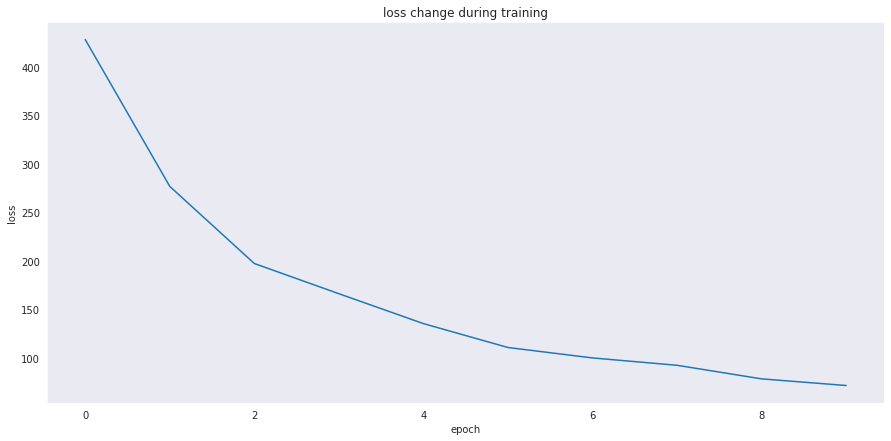
# predict on testing data samples (the accuracy here is batch accuracy)y_pred_list = []y_true_list = []with torch.no_grad(): with tqdm(test_dl, unit="batch") as tepoch: for inp, labels in tepoch: inp, labels = inp.to(device), labels.to(device) y_test_pred = model(inp) acc = multi_acc(y_test_pred, labels) _, y_pred_tag = torch.max(y_test_pred, dim = 1) tepoch.set_postfix(accuracy = acc.item()) y_pred_list.append(y_pred_tag.cpu().numpy()) y_true_list.append(labels.cpu().numpy())100%|██████████| 57/57 [00:35<00:00, 1.60batch/s, accuracy=75]# flatten prediction and true listsflat_pred = []flat_true = []for i in range(len(y_pred_list)): for j in range(len(y_pred_list[i])): flat_pred.append(y_pred_list[i][j]) flat_true.append(y_true_list[i][j])print(f"number of testing samples results: {len(flat_pred)}")number of testing samples results: 3600# calculate total testing accuracyprint(f"Testing accuracy is: {accuracy_score(flat_true, flat_pred) * 100:.2f}%")Testing accuracy is: 87.11%# Display 15 random picture of the dataset with their labelsinds = np.random.randint(len(test_set), size=15)fig, axes = plt.subplots(nrows=3, ncols=5, figsize=(15, 7), subplot_kw={'xticks': [], 'yticks': []})for i, ax in zip(inds, axes.flat): img, label = test_set[i] ax.imshow(img.permute(1, 2, 0)) ax.set_title(f"True: {test_set.dataset.classes[label]}\nPredicted: {test_set.dataset.classes[flat_pred[i]]}")plt.tight_layout()plt.show()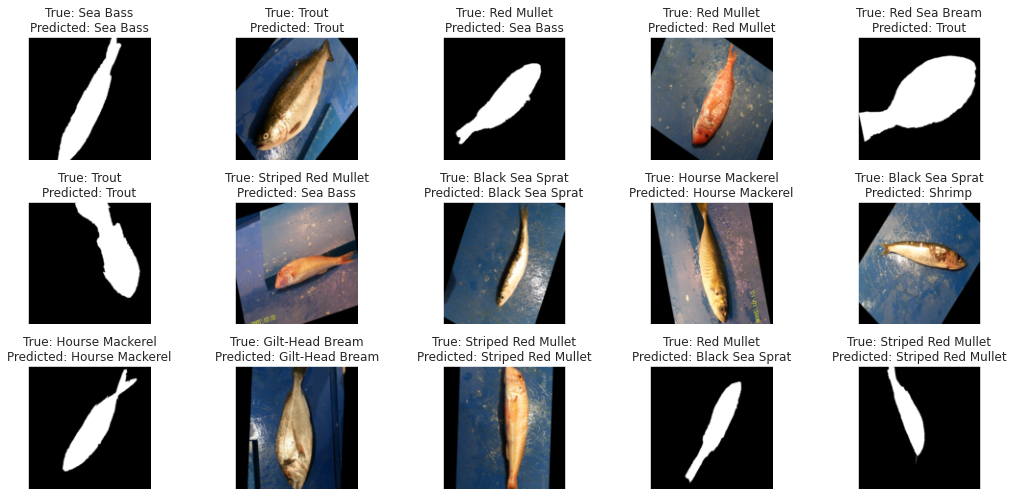
# classification reportprint(classification_report(flat_true, flat_pred, target_names=images.classes)) precision recall f1-score support Black Sea Sprat 0.88 0.85 0.87 428 Gilt-Head Bream 0.88 0.84 0.86 412 Hourse Mackerel 0.99 0.91 0.95 403 Red Mullet 0.79 0.91 0.84 391 Red Sea Bream 0.86 0.88 0.87 406 Sea Bass 0.87 0.94 0.90 364 Shrimp 0.81 1.00 0.90 420Striped Red Mullet 0.97 0.55 0.70 392 Trout 0.87 0.95 0.91 384 accuracy 0.87 3600 macro avg 0.88 0.87 0.87 3600 weighted avg 0.88 0.87 0.87 3600# plot confusion matrixidx2class = {v: k for k, v in images.class_to_idx.items()}confusion_matrix_df = pd.DataFrame(confusion_matrix(flat_true, flat_pred)).rename(columns=idx2class, index=idx2class)sns.heatmap(confusion_matrix_df, annot=True, fmt='').set(title="confusion matrix", xlabel="Predicted Label", ylabel="True Label")plt.show()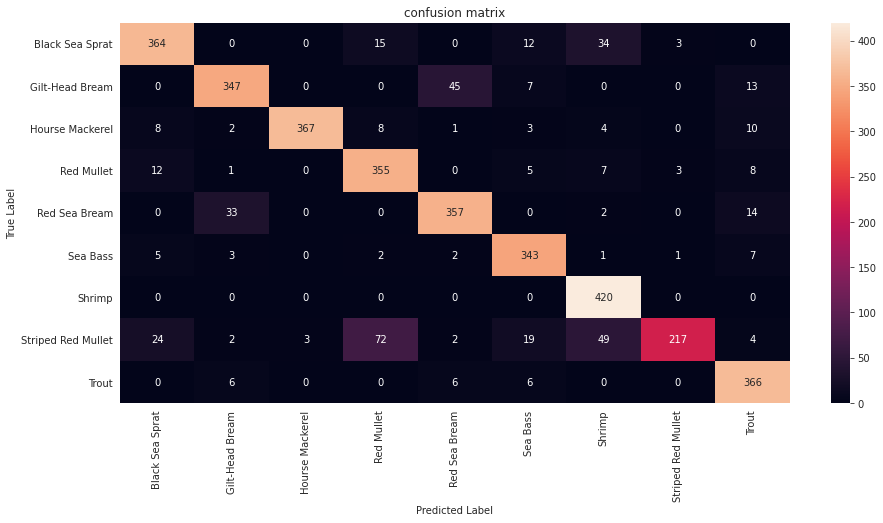
Conclusion
in this project we classified 9 different classes of fish at an decent accuracy of 87% with most of the classes having good percision and recall, however the model can be improved further by employing some techniques such as:
- Transfer learning: using pre-trained models.
- Learning rate scheduling: chaging the learning rate throughout the training process.
- Gradient clipping: setting threshold for gradient values.
- using Dropout layers.