
This notebook classifies credit card transactions to fraudulent or non fraudulent, the dataset is a set of PCA features extracted from the original data in order to conceal the identities of the parties in question.
# install torchsummary!pip install -q torchsummary[33mWARNING: Running pip as root will break packages and permissions. You should install packages reliably by using venv: https://pip.pypa.io/warnings/venv[0mimport torchimport torch.nn as nnimport pandas as pdimport matplotlib.pyplot as pltimport seaborn as snsfrom numpy import sumfrom sklearn.metrics import confusion_matrix, classification_reportfrom sklearn.model_selection import train_test_splitfrom sklearn.preprocessing import StandardScalerfrom torch.utils.data import TensorDataset, DataLoaderfrom tqdm import tqdmfrom torchsummary import summary# set figure sizeplt.rcParams["figure.figsize"] = (14,7)df = pd.read_csv("../input/creditcardfraud/creditcard.csv")df.head()| Time | V1 | V2 | V3 | V4 | V5 | V6 | V7 | V8 | V9 | ... | V21 | V22 | V23 | V24 | V25 | V26 | V27 | V28 | Amount | Class | |
|---|---|---|---|---|---|---|---|---|---|---|---|---|---|---|---|---|---|---|---|---|---|
| 0 | 0.0 | -1.359807 | -0.072781 | 2.536347 | 1.378155 | -0.338321 | 0.462388 | 0.239599 | 0.098698 | 0.363787 | ... | -0.018307 | 0.277838 | -0.110474 | 0.066928 | 0.128539 | -0.189115 | 0.133558 | -0.021053 | 149.62 | 0 |
| 1 | 0.0 | 1.191857 | 0.266151 | 0.166480 | 0.448154 | 0.060018 | -0.082361 | -0.078803 | 0.085102 | -0.255425 | ... | -0.225775 | -0.638672 | 0.101288 | -0.339846 | 0.167170 | 0.125895 | -0.008983 | 0.014724 | 2.69 | 0 |
| 2 | 1.0 | -1.358354 | -1.340163 | 1.773209 | 0.379780 | -0.503198 | 1.800499 | 0.791461 | 0.247676 | -1.514654 | ... | 0.247998 | 0.771679 | 0.909412 | -0.689281 | -0.327642 | -0.139097 | -0.055353 | -0.059752 | 378.66 | 0 |
| 3 | 1.0 | -0.966272 | -0.185226 | 1.792993 | -0.863291 | -0.010309 | 1.247203 | 0.237609 | 0.377436 | -1.387024 | ... | -0.108300 | 0.005274 | -0.190321 | -1.175575 | 0.647376 | -0.221929 | 0.062723 | 0.061458 | 123.50 | 0 |
| 4 | 2.0 | -1.158233 | 0.877737 | 1.548718 | 0.403034 | -0.407193 | 0.095921 | 0.592941 | -0.270533 | 0.817739 | ... | -0.009431 | 0.798278 | -0.137458 | 0.141267 | -0.206010 | 0.502292 | 0.219422 | 0.215153 | 69.99 | 0 |
5 rows × 31 columns
# some stats about the dataprint(f"Number of data points: {df.size}")print(f"Number of Fradulant Transactions: {df['Class'].value_counts()[1]}")print(f"Number of non-fradulant Transactions: {df['Class'].value_counts()[0]}\n\n")sns.countplot(x=df["Class"], palette="YlGnBu").set(title="Class Balance Between Transcation Types")plt.show()Number of data points: 8829017Number of Fradulant Transactions: 492Number of non-fradulant Transactions: 284315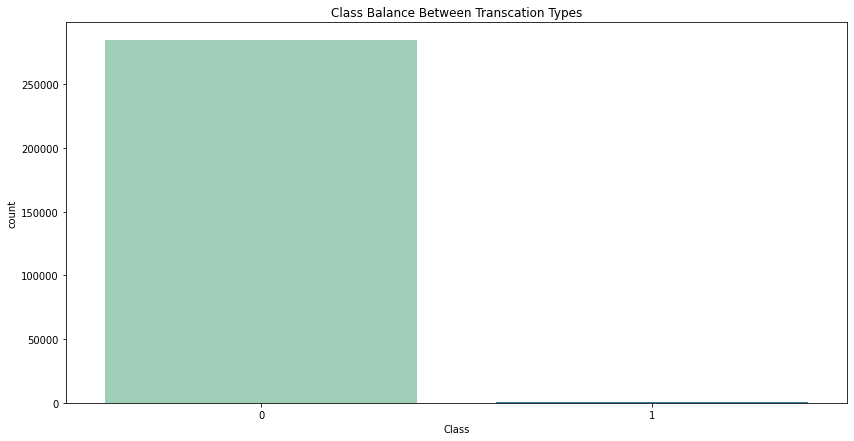
there is huge class impalance in the data, this might lead to a biased model, we can mitigate this by only using the same amount of class 0 while training or we could generate some sample data from the given features.
# Amount per transaction for each typesns.scatterplot(data=df.reset_index(), x="index", y="Amount", hue="Class", cmap="YlGnBu").set(title="Amount per transaction")plt.show()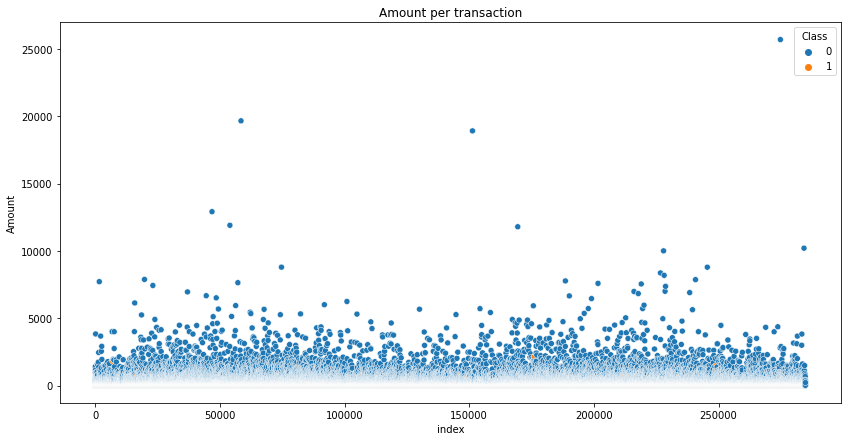
fraudulent transactions dont tend to have a large sum of cash per transaction, we can confirm this by calculating some statistics such as max, min and mean for each type of transaction.
for i, word in zip(range(2), ["Positive", "Negative"]): print(f"{word} transactions statistics") print(df[df["Class"] == i]["Amount"].describe(), "\n\n")Positive transactions statisticscount 284315.000000mean 88.291022std 250.105092min 0.00000025% 5.65000050% 22.00000075% 77.050000max 25691.160000Name: Amount, dtype: float64Negative transactions statisticscount 492.000000mean 122.211321std 256.683288min 0.00000025% 1.00000050% 9.25000075% 105.890000max 2125.870000Name: Amount, dtype: float64# split data into training and testingX = df.drop("Class", axis=1)y = df["Class"]# scale the values of x (better training)scaler = StandardScaler()scaler.fit(X)X = scaler.transform(X)# split data to train and testX_train, X_test, y_train, y_test = train_test_split(X, y, test_size=0.30, stratify=y) # stratify keeps class balance# create tensor datasets from dfX_train = torch.FloatTensor(X_train)X_test = torch.FloatTensor(X_test)y_train = torch.FloatTensor(y_train.values)y_test = torch.FloatTensor(y_test.values)train_ds = TensorDataset(X_train, y_train)device = 'cuda' if torch.cuda.is_available() else 'cpu'print(device)cuda# create dataloadersbatch_size = 128train_dl = DataLoader(train_ds, batch_size=batch_size)# Network Architectureclass FraudNet(nn.Module): def __init__(self, input_dim, hidden_dim, num_layers=4): super().__init__() self.input = nn.Sequential( nn.Linear(input_dim, hidden_dim), nn.ReLU() ) # make the number of hidden dim layers configurable self.layers = nn.ModuleList() for i in range(num_layers): self.layers.append(nn.Linear(hidden_dim, hidden_dim)) self.layers.append(nn.ReLU()) # final layer self.fc = nn.Linear(hidden_dim, 2) def forward(self, x): out = self.input(x) for layer in self.layers: out = layer(out) return self.fc(out)# training functiondef train_model(model, epochs, loss_fn, optimizer): model.train() for epoch in range(epochs): with tqdm(train_dl, unit="batch") as tepoch: for data, target in tepoch: data, target = data.to(device), target.to(device) tepoch.set_description(f"Epoch {epoch}") optimizer.zero_grad() preds = model(data) loss = loss_fn(preds, target.long()) loss.backward() optimizer.step() tepoch.set_postfix(loss=loss.item())inp_size = X_train.shape[1]model = FraudNet(inp_size, inp_size).to(device)loss = nn.CrossEntropyLoss()optim = torch.optim.Adam(model.parameters(), lr = 1e-4)# summarize the model layerssummary(model, (inp_size, inp_size))---------------------------------------------------------------- Layer (type) Output Shape Param #================================================================ Linear-1 [-1, 30, 30] 930 ReLU-2 [-1, 30, 30] 0 Linear-3 [-1, 30, 30] 930 ReLU-4 [-1, 30, 30] 0 Linear-5 [-1, 30, 30] 930 ReLU-6 [-1, 30, 30] 0 Linear-7 [-1, 30, 30] 930 ReLU-8 [-1, 30, 30] 0 Linear-9 [-1, 30, 30] 930 ReLU-10 [-1, 30, 30] 0 Linear-11 [-1, 30, 2] 62================================================================Total params: 4,712Trainable params: 4,712Non-trainable params: 0----------------------------------------------------------------Input size (MB): 0.00Forward/backward pass size (MB): 0.07Params size (MB): 0.02Estimated Total Size (MB): 0.09----------------------------------------------------------------epochs = 10train_model(model, epochs, loss, optim)Epoch 0: 100%|██████████| 1558/1558 [00:11<00:00, 137.25batch/s, loss=0.000822]Epoch 1: 100%|██████████| 1558/1558 [00:11<00:00, 138.96batch/s, loss=0.000756]Epoch 2: 100%|██████████| 1558/1558 [00:11<00:00, 139.36batch/s, loss=0.0022]Epoch 3: 100%|██████████| 1558/1558 [00:11<00:00, 133.62batch/s, loss=0.00293]Epoch 4: 100%|██████████| 1558/1558 [00:11<00:00, 137.87batch/s, loss=0.00276]Epoch 5: 100%|██████████| 1558/1558 [00:11<00:00, 137.02batch/s, loss=0.00241]Epoch 6: 100%|██████████| 1558/1558 [00:11<00:00, 135.01batch/s, loss=0.00206]Epoch 7: 100%|██████████| 1558/1558 [00:11<00:00, 139.75batch/s, loss=0.0018]Epoch 8: 100%|██████████| 1558/1558 [00:11<00:00, 134.36batch/s, loss=0.00159]Epoch 9: 100%|██████████| 1558/1558 [00:11<00:00, 138.24batch/s, loss=0.00143]model.eval()preds = model(X_test.to(device)).argmax(dim=1)print(classification_report(y_test, preds.cpu())) precision recall f1-score support 0.0 1.00 1.00 1.00 85295 1.0 0.90 0.76 0.82 148 accuracy 1.00 85443 macro avg 0.95 0.88 0.91 85443weighted avg 1.00 1.00 1.00 85443class_def = {0 : "Not Fraudulent", 1 : "Fraudulent"}cm_df = pd.DataFrame(confusion_matrix(y_test, preds.cpu())).rename(columns=class_def, index=class_def)cm_df = cm_df / sum(cm_df)sns.heatmap(cm_df, annot=True, fmt='0.2%', cmap="YlGnBu").set(title="Confusion Matrix", xlabel="Predicted Label", ylabel="True Label")plt.show()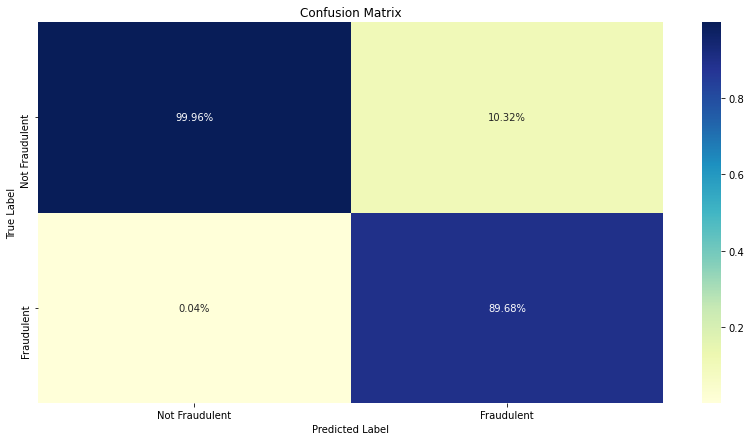
as expected the model does have some issue with classifiying fraudulent transactions, this can be addressed in multiple ways:
- use the same amount of data for both classes
- generate more data for fraudulent class 1
- use a deeper network (more layers)
- use a different network architecture
- use other algorithms